False Unity and “Moving On” is Dangerous
Even before yesterday’s inauguration of Joe Biden and Kamala Harris as the new President and Vice President of the United States, there were calls for unity—even empathy—and not just from Joe Biden. Such calls seemed very premature at the time, given the efforts of Trump and his allies to overturn the election result. With the failure of those efforts, despite a literal assault on the entire legislative branch incited by Trump resulting in five dead, such calls for unity and healing look even more naive.
Too many so-called conservatives (and some of those further left on the political spectrum) would rather put unity ahead of accountability. MAGA adherents and believers in the QAnon conspiracy theory essentially invaded the US Capitol and delayed the legislative branch from executing its responsibility to certify the Electoral College results at the urging of the president and his allies. They may have been aided and abetted in this insurrectionist act by multiple members of the GOP in both the Senate and the House. At least one shared the location of Speaker Pelosi on Twitter, as if to direct insurrectionists to her location. The wife of a Supreme Court justice may have funded the transportation to the Capitol for some of these insurrections. Even the death toll, the damage to the US Capitol, and the risk to their own lives did not prevent some Republicans from voting against certification of the Electoral College tally once the Capitol was secured.
Placing unity before accountability too many times before is what has led the country here. Unity before accountability killed Reconstruction, subjecting black Americans to almost another century of domestic terrorism, property theft, and subjugation at the hands of whites. The Nixon pardon, the Iran/Contra pardons, and the lack of accountability for those who engaged in torture and warrant less wiretapping of US citizens all placed unity before accountability. All of these actions paved the way for President Trump to be acquitted despite clear evidence that he tried to shake down the president of Ukraine in exchange for the announcement of an investigation into Hunter Biden.
Less than a year has elapsed between the Senate's acquittal of Trump on two impeachment charges and the insurrection on January 6. Only a tiny number of GOP House members put their country ahead of their party in voting for a second impeachment. A second acquittal for Trump seems likely--and we will live to regret it.
The Minimum Wage Debate is Too Narrow and Small
Recently I've found myself having variations of the same conversation on social media regarding the minimum wage. Those to my political left have made statements such as "if your business would fail if you paid workers $15/hour you're exploiting them." Those to my political right--some current or former business owners, some not--argue that minimum wage increases had a definite impact on their bottom line.
I have two problems with the first argument: (1) it oversimplifies and trivializes a very serious issue, (2) these days, the arguers tend to aim it at small business owners. Worker exploitation is real, and conflating every employer who follows the law when it comes to pay and other facets of employment harms the cause of combatting serious harms. The outgoing Trump administration has been trying to reduce the wages of H-2A workers. Undocumented workers in sectors like agriculture, food, home-based healthcare, and others fare even worse. In some cases, drug addiction treatment has turned thousands of people into little more than indentured servants, with complicity from judges and state regulators. Until recently, large corporations like Wal-Mart and Amazon evaded accountability for low worker pay and mistreatment despite having significant percentages of workers on food stamps and Medicaid and a high rate of worker injuries.
Another variation of the first argument takes a starting point in the past (like the 1960s) then says the minimum wage should be whatever the rate of inflation would have grown it to be between then and today. If you go back to when Dr. Martin Luther King, Jr. was alive (for example), the minimum wage today "should" be $22/hour. You can pick any point in time and say what the minimum wage should be based on inflation, but that's not the same as grappling honestly with how industries have changed and/or how the nature of work has changed in the half-century plus since the civil rights era.
One challenge with the second argument is that the examples cited are typically restaurants or food services--businesses that operate at low margins and have high fixed costs in addition to being labor-intensive. Even in that sector, the impacts of a $15/hour minimum wage are not necessarily what you might expect. But not every business is the restaurant business, and a single sector cannot govern the parameters of debate for an issue that impacts the entire economy and the broader society get a broadly beneficial result.
At this point in the discussion, someone usually brings up automation, followed by someone mentioning universal basic income (UBI). What I have said in the past, and will continue to say, is that automation is coming regardless of what the federal government, states, and/or localities do with the minimum wage. As someone who has written software for a living for over 20 years, the essence of my line of work is automating things. Sometimes software augments what people do by taking over rote or repetitive aspects of their jobs and freeing them up to do more value-added work. But if an entire job is rote or repetitive, software can and does eliminate jobs. The combination of software and robots are what enable some manufacturers to produce so many goods without the large number of workers they would have needed in the past.
Talking about UBI enlarges the conversation, but even then may not fully take on the nature of the relationship between government, business, and people. We do not talk nearly often enough about how long the United States got by with a much less-robust social safety net than other countries because of how much responsibility employers used to take on for their employees. Nor do we talk about the amount of additional control that gives employers over their employees--or the cracks in the system that can result from unemployment. The usual response from the political right whenever there is any discussion of separating health care from employment is to cry "socialism". But the falseness of such charges can be easily exposed. Capitalism seems to be alive and well in South Korea, and they have a universal healthcare system--a significant portion of which is privately funded. Germany is another country where capitalism, universal healthcare, and private insurers seem to be co-existing just fine.
The conversation we need to have, as companies and their shareholders get richer, share fewer of those gains with their workers, and otherwise delegate responsibilities they used to keep as part of the social contract, is how the relationship between government, business, and people should change to reflect the current reality. The rationale always given for taxing capital gains at a lower rate than wages was investment. But as we've seen both in the pandemic, and in the corporate response to the big tax cut in 2017, corporate execs mostly pocketed the gains for themselves or did stock buybacks to further inflate their per-share prices. Far from sharing any of the gains with workers, some corporations laid off workers instead. Given ample evidence that preferential tax treatment for capital gains does not result in more investment, the preference should end. People of working age should not be solely dependent on an employer or Medicare for their healthcare. A model where public and private insurance co-exist for those people and isn't tied to employment is where we should be headed as a society.
We need to think much harder than we have about what has to change both to account for the deficiencies in our social safety net (that corporations will not fill), and an economy on its way to eliminating entire fields that employ a lot of people today. Bill Gates advocated in favor of a tax on robots year ago. The challenges of funding UBI and whether or not it's possible to do that and continue to maintain the social safety net as it currently exists need to be faced head-on. Talking about the minimum wage alone--even as multiple states and localities increase it well beyond the federal minimum--is not enough.
Only a Little Forgiveness for Old Debts
I came across this parsimonious student loan forgiveness proposal in a tweet earlier today. The author, Beth Akers, even had the nerve to call this stingy proposal a student-loan jubilee. The $5000 (which isn't even cash, but a 1-time tax credit), is just 1/6th the average total student debt for recent college graduates. She ends her piece this way:
More than half of Americans have built their lives and made ends meet without a college degree. Call universal student loan cancellation what it is: elitist.
The conservative think tank crowd never seems to have a problem with the government giving away money to businesses, and are quick to hand wave away any evidence of abuse of such programs by big businesses. But the moment there's even a chance of the government doing something to help individuals, we get to hear a lot of concern about taxes and budgets, along with faux populism.
A cursory amount of digging reveals that the picture of who owes student loan debt is different than the stereotypical "whiny millennial" (some of whom are much closer to 40 than they are to 20). A Forbes piece from February of this year is particularly enlightening. The piece is worth reading in full but here are some of the facts I found most interesting:
- Of the $1.6 trillion in student debt owed, Texas and Florida rank 2nd and 3rd in the number of borrowers and amounts owed (California and New York rank 1st and 4th).
- Ohio, Illinois, and Michigan are also in the top 10 by number of borrowers and amounts owed
- Arizona and Florida rank 1st and 3rd in the nation in average student loan debt per capita
- Over $300 billion of that $1.6 trillion is owed by people aged 50 or older.
- The 50+ cohort of student loan borrowers is about the same size as the 24 and younger cohort (a little over 8 million borrowers), but the amount they owe is nearly triple the size of their younger counterparts.
So not only is student loan debt not merely the province of the young, nor is it restricted to "coastal elites". You could be eligible for retirement and still owe Sallie Mae. If the student loans you owe are private, there's no guarantee that debt will be forgiven upon your death.
I am quite fortunate when it comes to student loan debt. Graduating with a computer science degree from a state university with zero debt (thanks to parents who paid in full, and a state smart enough to subsidize in-state tuition) meant that I didn't incur any student loan debt until I decided to go to grad school. In the interim, I was able to buy a home.
Attending grad school part-time at night while working full-time (as my parents did for their undergraduate and graduate degrees, while raising my sister and I) and paying at least some tuition while in school mean that the amount I currently owe is well below the average for recent college graduates. Even so, it will be another decade from now before I've finished paying off Sallie Mae. I'll be thinking seriously about higher education for my own children then, since my twins will be in high school 10 years from now.
What the green eyeshade crowd is missing is that the $1.6 trillion owed by students is preventing them from putting their earnings elsewhere in the economy, such as home ownership or investment. That debt is almost certainly a factor in whether or not people choose to have children. Akers harking back to an era where a college degree was not a necessity to live a middle class life does not change the facts about the type of globalized economy we live in today. Nor does it change the fact that automation isn't just changing "low-skilled" labor, but also some of the jobs that a college degree formerly provided a gateway to. If you actually want to grow the middle class in the United States in anything approaching a sustainable fashion, a solution to student loan debt (both the current amounts, and a mechanism to prevent forgiven debt from simply growing back to even higher amounts) is just one part of a larger conversation.
Life and Religious Liberty for Me, But Not for Thee
With Amy Coney Barrett now on the Supreme Court and weighing in on cases, the payoff to the evangelical right for their unstinting support of Donald Trump becomes even clearer than it has already been. She joined a narrow majority to block COVID-19 limits on church occupancy. Despite numerous cases of COVID-19 outbreaks tied to church events (whether worship, choir practices, or other gatherings), despite over a quarter million Americans dead from COVID-19, the Supreme Court majority ignored the known science around how COVID-19 spreads because of "religious liberty". Much has been made of the fact that six of the nine justices on the Supreme Court are Catholic, but there were Catholic justices (including the Chief Justice) in the minority. Even the Pope was critical of those protesting restrictions on church attendance.
As someone who felt compelled to quit my first full-time job out of college because of constant pressure from my employer to work on my day of worship (as a Seventh-day Adventist, my family and I typically attend church on Saturday), I am angry that religious liberty is being used as the pretext to invalidate measures intended to preserve public health. When those measures (and stricter ones) have been applied elsewhere (parts of Europe, Australia, South Korea, New Zealand, etc), we've seen them work successfully in slowing and stopping the spread of COVID-19. Particularly because the same Supreme Court was not at all concerned about religious liberty when it came to the Muslim travel ban (the Quakers, among others, see the hypocrisy clearly), the ruling seems especially hollow. Plenty of churches (including my own) have stayed remote throughout the pandemic, either broadcasting services from empty sanctuaries except for themselves and musicians, or from home. I've given offering and tithed online. It is by no means an ideal experience, but given my own comorbidities it is better than risking my twins being orphaned.
Because Supreme Court confirmation fights (and the attendant press coverage) have focused so narrowly on where a nominee stands regarding Roe v. Wade, no attention has been paid to their stances regarding other issues quite relevant to life--and death. Invalidating restrictions on church occupancy during a pandemic is just one of the ways in which "pro-life" applies very poorly to describing where a justice actually stands. As the clock runs out on the Trump presidency, the Department of Justice under Bill Barr is accelerating the pace of executions. Barrett has already participated in her first capital punishment case on the Supreme Court. She did not recuse herself, nor register her opposition to the execution going forward as justices in the minority did.
I suppose it has always been this way, but when a lot of people talk about religious liberty, they only want it for themselves--and no one else.
Rest In Peace David Prouse
I’ve loved science fiction and fantasy for as long as I can remember. But I hadn’t thought much lately about exactly where that love began until a phone call from my mom today. She called to let me know that David Prouse had died. While James Earl Jones was the unforgettable voice of Darth Vader, David Prouse was who we all saw.
Before tonight’s conversation, where she reminisced about taking my sister and I to see it in the theater, I distinctly remember her taking me to see Return of the Jedi in the theater when I was 9. I remember the anticipation of seeing and just how much I enjoyed it. But when she mentioned my sister being in a stroller, I paused. Because my sister and I are 4 1/2 years apart, she wasn’t talking about when we saw Return of the Jedi. My mom was talking about the preceding movie—The Empire Strikes Back. While I’ve seen it many times since then in almost every conceivable format save LaserDisc, I didn’t remember the very first time. She thought I would be scared of Darth Vader, but as she told me I mostly stared in awe.
So Rest In Peace to David Prouse. Thanks to you—and my mom—for starting my journey into science fiction.
Empathy Now
Predictably, the calls for empathy for “the other side” have already begun. This tweet from Ian Bremmer is one example:
[twitter.com/ianbremme...](https://twitter.com/ianbremmer/status/1325135387707269121?s=21)
While I understand the sentiment, I find these demands for empathy to be premature. The speed with which these demands have come (and the people they tend to come from) tell me that they do not know anyone who has been hurt by the effects of Trump's policies--much less have been hurt themselves.
One of my former co-workers had his wife prevented from joining him here because of the Muslim ban. He and I were working on a contract at the U.S. Customs and Immigration Service at the time. Another co-worker from that time was married to someone from one of the banned countries. Imagine trying to explain to your child what the president said about the place you come from, and your faith.
For years I have listened to Trump and his supporters attack birthright citizenship--the very thing that makes me an American. I've seen his administration make it harder to become a citizen legally and try to strip citizenship from naturalized citizens like my parents. I have quite a few friends from the places Trump called "shithole countries". I've stressed out along with my staff and friends at work about whether or not their visas would be renewed as they navigated a process made deliberately harder by the Trump administration.
The people who voted for Trump--twice in some cases--meant for us to endure another 4 years of these assaults on citizenship, faith, and dignity. Even as I write this, some of his supporters are amplifying Trump's baseless charges of voter fraud. To ask those who opposed Trump to show empathy to his supporters now shows a real lack of understanding for the profound harm Trump's presidency has inflicted on marginalized people (and likely will still inflict because his presidency doesn't officially end until Inauguration Day in January 2021).
Sympathy may be possible later, perhaps even empathy--even though his supporters certainly displayed none who disagreed with them in 2016--because those of us who at least attempt to take our Christianity seriously believe Matthew 5:44 to be a command, not a suggestion. But it will not be on anyone else's timetable.
2016 Was Not an Anomaly
As of this writing, we lack certainty regarding the outcome of the 2020 presidential election. But we know enough to be sure that 2016 was not an anomaly. Trump has already surpassed his vote total from 2016 by over 4 million votes. In the midst of a pandemic that has claimed the lives of nearly a quarter million of our fellow citizens—due in significant part to the incompetent handling of the pandemic—Trump still has a path to a second term. Despite the open corruption and self-dealing, despite Trump's racism and misogyny, despite impeachment and a trial for pressuring President Zelensky into opening an investigation into Biden, 4 million more voters want a second Trump term.
Those 4 million additional votes for Trump include improving on his performance with Hispanic voters. While it is easier to see hindsight (as most things are), the combination of the Supreme Court preventing Trump from cancelling DACA, the targeting of previous fear mongering about "caravans" not being directed at Cuban-Americans (or not perceived by them as such), and the successful branding of Democrats as socialists by their GOP opponents seems to have resulted in a faster and clearer result favoring Trump in Florida than in 2016. Even some of those targeted by the caravan rhetoric have not been swayed from their support of Donald Trump. This election should mark the official death of the "demographics is destiny" idea that Democrats have been operating under for many years. As Chris Ladd puts it perfectly in this paragraph from a piece written November 2, 2020:
"Democrats’ POC coalition was premised on the notion that these targets of white racism would recognize their common interests and unite in resistance. Thing is, many don’t want to risk sharing the fate of Blacks in America. Educated whites and more affluent immigrants generally feel safe from being treated like Blacks, but less affluent newcomers on the margins of whiteness don’t. Rather than joining forces with this coalition, many immigrants see an alternative path to safety – becoming white."
Becoming White: The Weakness in Democrats' "People of Color" Coalition
Another key factor in Trump's apparent Florida victory: the successful imposition of what is effectively a poll tax by Florida's GOP governor and legislature prevented nearly a million Floridians who had completed sentences for felony crimes from voting. They did this in clear defiance of the 65% of Floridians voted in favor of automatic restoration of voting rights in 2018.
While the Democrats appear to have retained control of the House of Representatives (including all 4 original members of The Squad), the majority will be smaller than it was after the 2018 midterms. Even as Cori Bush joins The Squad, QAnon will seat its first congresswoman, and Madison Cawthorn (known for a bucket list that included visiting Hitler’s Eagles Nest) will become the youngest member of North Carolina's delegation to Congress--and of the entire body.
As significant as the uncertainty regarding the presidential election is, the GOP appears to have retained control of the Senate as well. The electorate not seeing fit to punish any of the senators who have enabled all of Trump’s excesses has created a huge opening for a slightly more subtle authoritarian to successfully challenge Biden, Harris, or whoever else the Democrats put up for the presidency in 2024. Tom Cotton, Ted Cruz, Tucker Carlson, and/or one of Trump’s children seem likely candidates to at minimum form exploratory committees if not follow through and run to succeed Donald Trump. Even in the event Trump loses the 2020 election, I would not rule out the prospect of Donald Trump running for re-election in 2024.
The Senate remaining in GOP hands even if Biden wins kills most (if not all) prospects for meaningful legislation to reform the issues we've seen during the past four years. If the latest anti-ACA lawsuit succeeds with the 6 conservative justices now seated on the Supreme Court, millions of Americans will lose the healthcare insurance they gained because of it and millions more (including myself) with pre-existing conditions at risk of becoming uninsured (and uninsurable) due to changes in employment. Without control of the Senate, Democrats would have little power to put a legislative fix into law. The same would be true of nearly any law the GOP chooses to make a court case out of. Because this same Senate has stocked the lower court with Trump appointees (mostly political hacks with law degrees rather than serious jurists), such cases reaching SCOTUS if lower courts don't rule the way the GOP prefers seems more likely than not. GOP control of the Senate almost certainly puts a wrench in any plans Biden has for staffing cabinet and sub-cabinet positions requiring Senate confirmation.
While it appears that Biden may yet win the presidency, we know that for the second consecutive election and the third in just 20 years, a minority of American voters has (for now) successfully stymied the will of a majority of American voters at the ballot box thanks to the Electoral College.
Kamala
Perhaps unlike most people of Jamaican or West Indian descent, I was somewhat conflicted by Biden’s selection of her to be his vice president. During her presidential run, a lot of people focused on her responses to the questions about whether or not she smoked weed in college (and what music she listened to). What put me off about her response was not that she smoked, but that she used the Jamaican part of her heritage as an excuse to lean hard into a stereotype about the island and its people. Her father apparently had a similar reaction.
Even without the bad weed joke, some of my conflict was regret that Colin Powell wasn’t first. I came of age politically at a time when his name was bandied about as a possible vice president and when he thought about running for president himself. As a teenager, I was thrilled at the prospect that someone just like me–right down to both parents immigrating here from Jamaica–would run for president. I even said at the time (and again in a recent family group chat) that I’d have volunteered for a Colin Powell presidential campaign.
Despite my conflict, I wish the Biden-Harris ticket success. They would give this country at least a chance to move toward its stated ideals. And as for the commentary in some quarters regarding how insufferable Howard graduates will be, or AKA sorority sister will be, (or Jamaicans), I welcome that prospect. Jamaica has always punched above its weight culturally. A vice president of Jamaican descent would just be the latest example.
Thoughts on "Cancel Culture"
On Twitter, I'm one of those guys who tweets "At-will employment" every time someone loses their job because they did something stupid enough publicly enough that their employer decides the cost of their continued employment is too high. Lately that stupid thing tends to be something racist, and given the various and sundry ways at-will employment has put people--including myself--out of work in the past, I'm 100% okay with racist deeds being added to the list of things that can make you unemployed. Amy Cooper getting fired from her job at Franklin Templeton because she went viral for calling the cops on Christian Cooper (a black man) under false pretenses isn't "cancel culture". That's the downside of at-will employment.
In October 2017, Juli Briskman was out cycling one weekend in northern Virginia when President Trump's motorcade passed her on the road. She gave the motorcade the middle finger. When she informed her employer (a government contractor) that she was the woman in the picture that had gone viral on social media, they fired her. That wasn't "cancel culture" either, just the downside of at-will employment (the wrongful-termination lawsuit she filed the following year was dismissed for that reason). The same is true of the white supremacist and neo-Nazi attendees of the Unite the Right rally who were fired by their employers after being identified. So how do these examples connect to the Letter on Justice and Open Debate?
The signatories of this letter (at least a few of whom went on Twitter to withdraw support from it after they learned who else had signed) purport to be concerned about the weakening of "our norms of open debate and toleration of differences in favor of ideological conformity". This begs the question of what is being debated, and what differences people are refusing to tolerate in favor of ideological conformity. "Editors are fired for running controversial pieces;" hints at one such example, but gets the key fact wrong. James Bennet, who did not read the Tom Cotton op-ed he chose to publish, resigned as the head of New York Times Opinion--he was not fired. The piece in question was updated with a 317-word editors' note indicating the piece "fell short of our standards and should not have been published". Another example "a research is fired for circulating a peer-reviewed academic study", refers to the firing of David Shor for retweeting the work of Professor Omar Wasow. Jonathan Chait writes about it at length in this piece, and argues far more persuasively against "left illiberalism" than the vague and anodyne Harper's letter because he is specific. When I first learned of the Shor firing, it seemed unjust to me--and still does. His employer did wrong in firing him, and doing so smacks of precisely the sort of "woke liberalism" that those to the right on the political spectrum often decry.
Another friend of mine asked for my thoughts on J.K. Rowling and Noam Chomsky signing the letter, so I'll address them specifically here. From the little I've seen on Twitter, Rowling is receiving backlash for some tweets and more detailed opinions regarding transgender people that could be characterized as transphobic. To me it is unsurprising that Rowling would sign the Harper's letter. There is no downside I can discern to signing onto a vague letter about free speech and tolerance for differing views, but it will not prevent those who see Rowling's positions as transphobic from being any quieter or less vehement in their opposition to her opinion. Chomsky is a scholastic giant who has influenced multiple fields of study. He has been an activist for many causes above and beyond free speech, subjected to multiple arrests, and earned a place on Nixon's enemies list for that activism, so unlike many others on the list he has demonstrated the courage of his convictions for decades.
I think Mansa Keita was on target regarding the objectives of the Harper's letter when he tweeted the following:
The term "cancel culture" is simply a rhetorical device meant to control the contours of acceptable speech. The speech and values of those telling you how you should speak is not more privileged than your own.
Another friend of mine quite recently described cancel culture as being "seated somewhere between McCarthyism and market forces". I find this description quite apt as well.
There are certainly other examples beyond those I've listed where the expression of one's opinion resulted in them losing a job. James Damore's firing by Google is one example from my line of work. Rush Limbaugh getting fired by ESPN some years ago is another. Twenty years before Colin Kaepernick began the silent protest against police brutality that would ultimately cost him his career, Mahmoud Abdul-Rauf was suspended by the NBA for refusing to stand during the anthem. Whether "cancellation" for one's expressed opinion is as prevalent or permanent as some claim is an open question. So is the assertion that many people are self-censoring due to fear of consequences for speaking out. Anecdotes (including those I've shared) are not data.
The signatories (all of whom have substantial platforms of their own from which to convey their opinions) seem to be asking for themselves, and presumably other less-powerful people that controversial speech be somehow more privileged than other speech. They seem to be asking for a "freedom from consequences" that Juli Briskman (and certain Unite the Right rally attendees) were not exempt from. This piece on Digg goes much further in exploring that ground, and deals more specifically with some of the letter's endorsers. If freedom from consequences is at heart what the Harper's letter is asking for, how do we square that demand with the current nature of at-will employment? Instead of vague open letters in magazines with a vanishingly small total circulation, do we reconsider the current nature of at-will employment? Do we ask employers to be braver? Do we go so far as to change laws? Or do we continue to complain about the status quo?
Academic tenure is the concept I think comes closest to what the endorsers of the Harper's letter are asking for. The intent of academic tenure as I understand it (not being an academic myself) is to preserve the freedom of academics to hold a variety of views. Academic tenure is not a guaranteed job for life however, though it is purposely difficult to fire a tenured professor. By the same token, academic tenure is exceedingly difficult to achieve. While this does not mean that a tenured professor expressing opinions I find abhorrent would not bother me any less, the difficulty of achieving tenure limits that possibility quite significantly.
Gatekeepers in spheres beyond academia no longer command the same power they once did. First blogging, then social media platforms disintermediated news organizations as ways of getting one's opinion heard more broadly. YouTube, Facebook, Twitter, and other platforms added virality to the mix. These platforms combined with ubiquitous cellphone cameras have disintermediated the police as the only source of information about their activities, providing brutal documentary evidence of the need for the police reforms the Harper's letter calls overdue. These platforms also make the letter's assertion that the free exchange of ideas is becoming more restricted a somewhat dubious one. There is probably more free exchange of ideas than ever--but within echo chambers of the like-minded. Those who believe in all manner of conspiracy theories can easily find their tribe in the same way fans of particular sports teams, musicians, or hobbies can. Those of us on different sides of any number of issues are more likely to talk past each other--or at each other--than with each other. The echo chambers and the absence of a shared set of facts may be as much of a danger--if not more so--than "cancel culture".
An Imperfect Dividing Line for Honor
America still wrestles with names, symbols and statues. But in the wake of George Floyd’s murder, some of the nation’s idols are falling faster than I can type. Just today came news that Princeton University is removing Woodrow Wilson’s name from their school of public policy and a residential college. Woodrow Wilson famously screened the pro-Klan Birth of a Nation at the White House in 1915. Earlier this week, the city council of Charleston, South Carolina voted unanimously to remove a statue of John C. Calhoun from their city square (and the removal work has already started, likely with a museum as its final destination). In addition to serving as Vice President, Secretary of State, and senator, Calhoun was perhaps this country’s most ardent defender of chattel slavery. The reckoning has even spread abroad, with protesters in Bristol, England pitching a statue of Edward Colston (a slave trader) into the harbor and Belgium beginning to remove statues of King Leopold II (brutal colonizer of the Congo).
Resistance to removing these men and certain symbols from places of honor still continues however. While Mississippi has begun the process of considering a new state flag (minus the Confederate flag insert), the current flag still has its defenders. A bust of Nathan Bedford Forrest (whose Confederate troops massacred black soldiers who surrendered at Fort Pillow, and later led the Ku Klux Klan) still stands in the Tennessee state house after an 11-5 vote against removing it in favor of another Tennessee historical figure.
Two things prompt my attempt to craft a dividing line (however imperfect) for honor:
- The toppling of a Ulysses S. Grant statue in San Francisco
- News of protesters' demands for the removal of an emancipation memorial in Washington, DC.
Adam Serwer’s defense of Grant is reason enough that no state of Grant should ever be abused in such a fashion. Professor Aderson Francois adds Grant’s role in the Civil Rights Act of 1875, and in a congressional commission that studied post-Civil War terrorism against black men and women in the South.
Professor David Blight (perhaps the best living authority on Frederick Douglass), writes an eloquent defense of The Freedmen’s Memorial. Before reading his column, there was so much about the monument I did not know:
- 100% of the $20,000 that funded its construction came from the formerly enslaved
- it was in part an homage to Lincoln after his assassination in 1865
- Frederick Douglass spoke at the unveiling--and was critical of Lincoln's attempts to have black people leave the country to establish colonies elsewhere both before and after emancipation.
Rather than take down this monument to Lincoln and emancipation, create a commission that will engage new artists to represent the story of black freedom from one generation to the next. Let today’s imaginations take flight. Perhaps commission a statue of Douglass himself delivering this magnificent speech. So much new learning can take place by the presence of both past and present. As a nation, let’s replace a landscape strewn with Confederate symbols with memorialization of emancipation. Tearing down the Freedmen’s Memorial would be a terrible start for that epic process.In response to the Blight column (which I shared with friends on Facebook), one of them asked me if I felt monuments to Thomas Jefferson should be torn down. Here is my response to him:
The short answer is no. The longer answer is while the hypocrisy of certain of the founders of the United States re: chattel slavery is obvious, they were trying to build a nation. I favor Dr. Blight’s approach of adding more context. The Confederate States of America and those who led it (by contrast) betrayed the nation the founders built and had the explicit goal of breaking this nation in two for the purpose of preserving and expanding the institution of chattel slavery. Statues of those who supported the Confederacy were erected to support the myth of the Lost Cause, and in concert with violence and terrorist acts against black people, despite the defeat of the Confederacy in the Civil War. With the exception of tombstones and gravesites, I would not preserve a single Confederate monument on public land were it up to me. Strike Confederate names from every military base, every road, every school, and/or other public facility as well.The Thomas Jefferson Memorial on the Tidal Basin is a place I've visited many times. The words of the Declaration of Independence inscribed on one of its panels are clearly at odds with Jefferson's treatment of the enslaved and profit from chattel slavery. Monticello, Jefferson's primary plantation, is attempting to address this contradiction even today. When it comes to the Founding Fathers, hagiography has characterized too much of our treatment of them. As more is revealed, it seems that what we have been taught as history looks more like propaganda. Continued denial of the unsavory, hypocritical, and contradictory beliefs and actions of America's founders serves the nation poorly. But destruction of their monuments may not serve us any better.
My First Juneteenth
Today marks the date in 1865 when General Gordon Granger read General Order 3 to the people of Galveston Bay, Texas, informing the enslaved there and in all of Texas of freedom that had been rightfully theirs two years earlier. That was essentially the full extent of my understanding of Juneteenth until recently, so I’ve taken the additional time off my employer gave us today to dig a bit deeper. Juneteenth.com, the Wikipedia entry about Juneteenth, and this explainer by Dr. Henry Louis Gates, Jr. have been my starting points. I shared these links with my direct reports as well as my co-workers before our 2PM close today, and was heartened by how generously they were received.
In today’s national discussions of and writing about Juneteenth, the role of Texas and black Texans doesn’t get nearly the prominence it should. Even as someone who has read The Warmth of Other Suns, and the way that aspects of black southern culture migrated north and west out of the South along with its people, it didn’t occur to me that holidays would or could migrate too. Once I looked at the map of dates when different states granted it official recognition however, it made sense that Minnesota and Florida were among the first states outside of Texas to grant that recognition before the year 2000. In reading a story like this one, it reinforces yet again that we in this country are fundamentally miseducated about its history when it comes to the Civil War, Reconstruction, its failure, and the consequences of that failure.
Even a widely-acclaimed documentary like Ken Burns' The Civil War–which my high school classmates and I watched parts of in history class on VHS after each episode aired–can’t convey just how determined some in this country were to preserve the institution of slavery. Only in reading about Juneteenth did I learn of plantation owners and other slaveholders migrating to Texas and bringing those they enslaved along with them to escape the fighting (and leveraging their distance from Union troops to extract years of additional labor from them). This thread by Aderson B. Francois, professor of law at Georgetown University, tells a story I definitely did not know about concerted efforts to make it unconstitutional to abolish slavery. Not only was the Corwin Amendment passed by both houses of Congress by the necessary margin to proceed to ratification, not only did Abraham Lincoln support it, but my home state was among five that ratified it (and only rescinded that ratification in 2014). Thanks to a friend I met back in grad school, I learned that some of the defeated Confederates attempted to preserve the Confederacy in Brazil.
Spending the time to learn more about Juneteenth has unearthed quite a few things done in previous years to focus attention on it, and the story of black people in this country more generally. This interview with Isabel Wilkerson from 2017 leads off with audio from the 1940s housed at the Library of Congress from a formerly-enslaved woman old enough to remember the original Juneteenth, and reflects upon the death of Philando Castile at the hands of police in the previous year. This piece on the National Museum of African American History and Culture website talks about the legacy of Juneteenth. A brief story from The History Channel originally published in 2015 talks about the Emancipation Proclamation and Juneteenth. I’m not sure how many other holidays have their own flag, but Juneteenth does and has for over 20 years.
Another interesting thing Juneteenth has done in the wake of George Floyd’s murder is spark good faith questions from white friends and co-workers about aspects of black history in the United States. While my heritage makes my connection to the term “black” more complicated, I refer friends to documentaries like 13th, and to the scholarship of Dr. William Darity to learn more about reparations.
In addition to spending at least a part of today learning more, I donated to two non-profits and encouraged friends to do so as well. The Innocence Project works to free those wrongly convicted of crimes. The Equal Justice Initiative operates The Legacy Museum and The National Memorial for Peace and Justice, which seek to educate about the history of enslavement, lynching, and mass incarceration of black Americans in the United States. Perhaps this Juneteenth will be the beginning of an annual tradition of learning and contributing to the cause of justice.
New MacBook Pro
The untimely death of the mid-2015 MacBook Pro that had been my primary machine the past few years meant I forking over for another laptop. Given the hassles that resulted from buying that machine from somewhere other than Apple or MicroCenter, I didn't take any chances with its replacement.
A refurbished version of this laptop (where I wrote this post) cost a little over $400 less than retail. I'm still in the process of setting things up the way I like them, but one new thing I learned was that Apple is still shipping their laptops with an ancient version of bash.
Having used bash since my freshman year of college (way back in 1992), I have no interest in learning zsh (the new default shell for macOS). So right after I installed Homebrew, I followed the instructions in this handy article to install the latest version of bash and make it my default shell.
There's still plenty of other work to do in order to get laptop the way I want it. Data recovery hasn't been difficult because of using a few different solutions to back up my data:
- Carbon Copy Cloner
- Backblaze
- Time Machine
I've partitioned a Seagate 4TB external drive with 1TB for a clone of the internal drive and the rest for Time Machine backups. So far this has meant that recovering documents and re-installing software has pretty much been a drag-and-drop affair (with a bit of hunting around for license information that I'd missed putting into 1Password).
I wasn't a fan of the Touch Bar initially, even after having access to one since my employer issued me a MacBook Pro with one when I joined them in 2017. But one app that tries to make it useful is Pock. Having access to the Dock from Touch Bar means not having to use screen real estate to display it and means not having to mouse down to launch applications.
Because of Apple's insistence of USB-C everything, that work includes buying more gear. The next purchase after the laptop itself was a USB-C dock. I could have gone the Thunderbolt dock route instead, but that would be quite a bit more money than I wanted or needed to spend.
Even without the accessories that will make it easier to use on my desk in my home office, it's a very nice laptop. Marco is right about the keyboard. I'll get over the USB-C everything eventually.
COVID-19 Doesn't Care About Our Politics
A friend on Twitter asked the following question:
Does the shortage of ventilators/mask[s] show the cruelty and inefficiency of capitalism? If so, would a centrally planned economy have better outcomes?My response:
It's nothing to do with capitalism being cruel or inefficient, and everything to do with what can happen when the profit motive is the main driver of private sector companies involved in the healthcare supply chain, and in healthcare provision.Even as the total of coronavirus cases worldwide has exceeded 1 million (as of April 2, 2020), it’s too easy to find people trying to use the pandemic in favor of their preferred ideology and against others. From my vantage point, no ideology is faring particularly well against coronavirus. Most of the countries at the top of the charts for total cases and new cases are democracies, but the top 10 also includes China (communist), the Islamic Republic of Iran, and Turkey (effectively a dictatorship).That combined with incompetently led governments both at the federal level and in some states are why the United States finds itself leading the way in the number of [novel] coronavirus cases.
What the coronavirus is highlighting (in addition to the problem of allowing the profit motive to take primacy in healthcare) is the importance of competent government–regardless of what ideology they claim or operate under. Many articles (including this one) have pointed out that South Korea and the United States reported their first positive COVID-19 case on the same day. The differing results of their responses couldn’t be more stark. South Korea has a tiny fraction of COVID-19 deaths compared to the United States, and a very low number of new cases.
Puerto Rico was a harbinger of the botched response to covid-19
In reading this excellent Financial Times piece, I was struck by this paragraph in particular:
People often observed during Trump’s first three years that he had yet to be tested in a true crisis. Covid-19 is way bigger than that. “Trump’s handling of the pandemic at home and abroad has exposed more painfully than anything since he took office the meaning of America First,” says William Burns, who was the most senior US diplomat, and is now head of the Carnegie Endowment.
It struck me as incorrect because I thought almost immediately of the poor federal response to the devastation in Puerto Rico wrought by hurricanes Irma and Maria in September 2017. Plenty of news stories at the time (including this one from the year after the storm) focused on Trump throwing paper towels at a crowd of hurricane survivors. But a closer look at such stories yields many examples of Trump, his administration, and others connected to them operating the same way nearly 3 years ago as they are now in their response to covid-19.
Looking at how the Trump administration talks about death tolls from covid-19 today, I see many similarities to how they talked about death tolls from the hurricanes in 2017. In this US News & World Report story from last month, Trump is quoted saying he's proud of what his administration has done, as well as insisting the death toll could have been much worse and that no one could have done better. In 2017, the BBC News story I linked earlier recounts Trump telling Puerto Rican government officials that they should be proud of the low reported death tolls from the two storms. This led me to another similarity between the handling of the two crises: under-reported death tolls.
The aftermath of the storms in Puerto Rico is when I first encountered the term "excess mortality". Researchers from Harvard did a study (including interviews with some 3000 randomly-selected Puerto Rican households the year after the storms) and estimated that some 4600 people died as a result of the damage done by Hurricane Maria due to interruptions in medical care caused by infrastructure damage such as power cuts and impassable roads, and suicides, as compared to the same time period in the previous year. The power cuts led me to yet another similarity between the aftermath of the hurricanes in Puerto Rico and the federal response to covid-19: contracts granted due to political connections instead of competence.
There have been numerous stories (like this one) about GOP fundraiser Mike Gula getting out of the fundraising business to start a company called Blue Flame to sell N95 masks, ventilators, and PPE despite having zero relevant experience. My home state (Maryland) and Trump's DOJ have both begun investigations into the company after it failed to deliver on contracts it signed. Nearly 3 years ago, a 2-year-old company with 2 employees named Whitefish Energy won a $300 million no-bid contract to restore Puerto Rico's wrecked power grid. The Interior Department insisted that Secretary Ryan Zinke played no role, despite his personal connections to the CEO of that company. Whitefish would ultimately lose that contract and Secretary Zinke would ultimately resign due to pressure from over a dozen different investigations launched into his conduct while serving as interior secretary.
Another way that Trump's response to covid-19 was predicted by his response to the hurricanes in Puerto Rico is in how he praised political leaders who played to his ego and blamed those who did not. In this story, Trump is quoted praising then-governor Ricardo Rossello (who had no criticism of federal recovery efforts) while attacking San Juan's mayor (Carmen Yulin Cruz). His complimentary words to the GOP governors of states (and his attacks on governors Whitmer, Inslee, and others) are very similar.
Further exploration would probably yield more similarities between the botched handling of Puerto Rico's recovery from the hurricanes and the federal government's continuing response to covid-19. Sadly, the island is not fully-recovered after 3 years and is now suffering the additional burden of covid-19. Denials of housing assistance by FEMA in the immediate aftermath of the hurricanes is inflicting consequences on Puerto Ricans--all US citizens--to this day.
Philanthropy is Marketing
This post is the product of a conversation with some friends on Slack, on the topic of billionaires and their philanthropy. What kicked off this thread of our ongoing conversation was this New York Post piece on Elon Musk. The column (which is worth reading in full) strings together some of Musk's frankly stupid tweets regarding CoVID-19 before correctly (and brutally) pointing out a few ways his attempts to "save the day" have fallen far short of what he promised. Here's the pull-quote from the piece added to our conversation:
Elon, it’s time to take a breath and think — and possibly research work that may not have been done by you — before you speak. Take a page from the founder of Twitter, Jack Dorsey, and put your money where your big mouth is (without constantly crowing about it). Dorsey, who has teamed up with Rihanna and Jay-Z to donate $6.2 million to CoVID-19 relief funds, recently announced the creation of Start Small LLC, using $1 billion of his own equity to “disarm this pandemic.” After that, the fund will “shift to … health and education” for girls.
According to Wikipedia, Jack Dorsey's net worth is slightly south of $4 billion, making his $1 billion offering against the pandemic at least a quarter of his net worth. The number of other billionaires donating that proportion of their current net worth to such a cause is zero. While that level of generosity is commendable, American society has become far too dependent on the noblesse oblige of billionaires.
Here's the comment from our conversation that prompted the title of this post:
But whining they [billionaires] aren't donating then whine when they do donate and most people haven't donated is also a double standard.
Right, the tax code needs to be fixed but the [R]epublicans have basically twisted the logic of "if you remove these billionaire tax writeoffs and loopholes it's gonna affect average joe making 40k a year" into the mind of their base.
It's some of the best marketing I've ever seen.
Scott Galloway has said something along these lines on at least one occasion: "philanthropy is marketing." For the various and sundry "tech bros" (and others) who do it, it represents a tiny fraction of their net worth for immense reputational gains. Consider Mark Zuckerberg's $100 million gift to reform public schools in Newark, or the Sackler family's support of the arts. Whether or not the money had the desired effect is incidental to how the public regards the people who gave the money--it "launders" their reputations (a necessary washing in light of what we now know about how they earned their billions). Even the amount Charles Kushner spent to buy Harvard a building with his name (and incidentally get his son a spot at the school he didn't earn with his grades) somehow counts as philanthropy.
Unfortunately, philanthropy doesn't just rehab reputations. More and more often it seems to be offered as a substitute for government involvement. Philanthropy has been offered as a substitute for a social safety net funded with taxes before. But it hasn't been (nor will it ever be) adequate to the scale of certain problems American society faces, whether we look at schools, poverty, pollution, public health, or any number of other challenges. The degree to which we have built an expectation of, if not a dependence on, the largesse of the very wealthy for key things is not merely sad but dangerous. Not only can their interests and focus change in a flash, but we have no mechanism for holding them accountable for failure. A properly-functioning society cannot and must not let this status quo regarding philanthropy continue.
(Stay) Inside
[embed][youtu.be/mKzVc0rTh...](https://youtu.be/mKzVc0rThK8)[/embed]
I came across a shorter clip of this great video thanks to a group called the Global Jamaica Diaspora Youth Council (@GlobalJAYouth on Twitter).
Résumé Shortening (and other résumé advice)
I saw a tweet from one of the best tech follows on Twitter (@raganwald) earlier today about the difficulty of shortening your résumé to five pages. While my career in tech is quite a bit shorter than his (and doesn't include being a published author), I've been writing software for a living (and building/leading teams that do) long enough to need to shorten my own résumé to less than five pages.
While I'm certainly not the first person to do this, my (brute force) approach was to change the section titled "Professional Experience" to "Recent Professional Experience" and simply cut off any experience before a certain year. The general version of my résumé runs just 2 1/2 pages as a result of that simple change alone.
Other résumé advice I've followed over the years includes:
- If there is a quantitative element to any of your accomplishments, lead with that. Prominently featured in my latest résumé are the annual dollar figures for fraud losses prevented by the team I lead (those figures exceeded $11 million in 2 consecutive years).
- Don't waste space on a résumé objective statement
- Use bullet points instead of paragraphs to keep things short
- Put your degree(s) at the bottom of the résumé instead of the top
- Make your résumé discoverable via search engine. This bit of advice comes from my good friend Sandro Fouché, who started the CS program at University of Maryland a few years ahead of me (and has since become a CS professor). I followed the advice by adding a copy of my current résumé to this blog (though I only make it visible/searchable when I'm actively seeking new work). His advice definitely pre-dates the founding of LinkedIn, and may predate the point at which Google Search got really good as well.
Speaking of LinkedIn, that may be among the best reasons to keep your résumé on the shorter side. You can always put the entire thing on LinkedIn. As of this writing, the UI only shows a paragraph or so for your most recent professional experience. Interested parties have to click "...see more" to display more information on a specific experience, and "Show n more experiences" where n is the number of previous employers you've had. Stack Overflow Careers is another good place to maintain a profile (particularly if you're active on Stack Overflow).
Jamaican Anatomy
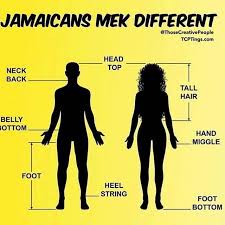
I remember having a good, long laugh about this particular image when one of my cousins shared it on Facebook awhile back. It reminds me that my parents were right about me being Jamaican, even though I was born and raised in America. When I became a dad, among the many parenting things I did (and still do) was baths. And while I was washing the twins (moreso when they were smaller than now), I would find myself calling out their body parts in patois as I washed them. “Come mek me wash your neck back”, and so on.
When I was growing up, I made no effort at all to speak patois–not even when we were in Jamaica visiting for weeks at a time. I even teased my younger sister for her attempts. But now the joke’s on me–in more ways than one. The patois that sneaks out when I’m not even thinking about it isn’t the only way the heritage is more firmly embedded than I realized in my youth.
Does Diversity & Inclusion Disadvantage Poor Whites?
I came across a Twitter thread today (it begins here) which argued that diversity & inclusion is “systematically marginalizing disadvantaged people from majority groups”. Having read the full argument and thought about it, the assertion has a number of problems in my view. The argument suffers from a fundamental error of attribution. If any member of the majority is disadvantaged, it is in economic status—and capitalism is the primary culprit there. The diversity part of D & I only began in the 1970s and 1980s, adding barriers to inclusion as a focus in the 1990s. Capitalism by contrast has a head start of approximately 300 years.
Capitalism has always exploited the economically-disadvantaged. Ethnicity is a variable often used to determine which of the poor to exploit first. This doesn’t mean that white people could not be disadvantaged—some of them certainly are. We should be clear that whiteness did not always include Eastern Europeans, Italians, Scots-Irish people, etc—they faced real limits in what kind of work they could do, where they could live, etc for many years until whiteness expanded to include them.
That said, Thomas Chatterton Williams (among many others) has already noted that historically, economic alliances between the poor that span ethnicities have been purposely attacked and broken by those who serve the interests of capital. If you’ve read about The Great Migration (black people fleeing north to escape domestic terrorism from the KKK and others between 1915 and 1970), black migrants arriving in the north often faced discrimination and violence from newly-arrived immigrants not yet even fully-included in whiteness.
Beyond the attribution error, the argument fails on a second but related front—the assertion that a single ideology built around D & I is marginalizing poor whites. At least one other ideology exists regarding D & I—an ideology built to oppose D & I. This ideology scapegoats some immigrants for blame when it comes to the economic disadvantage suffered by certain members of the majority—even as the capitalists it supports continue to exploit cheaper, non-white labor for increasing profit. Perhaps even more insidiously, it selects certain other immigrants as proof that capitalism is somehow meritocratic and just when quite often it is not.
To extend the analysis to higher education, the argument against D & I weakens even further by skipping over the gigantic inflation of tuition prices, the continuing existence of legacy admissions (which predominantly favor the majority group, and the wealthiest members of that group), and the role that gifts to schools from wealthy donors have in admission of their children, you should question it. Selective (if not dishonest) arguments like this are why my alma mater (which still uses legacy admissions) was ordered by a court ruling to open its Benjamin Banneker scholarship to non-black students. It’s how Abigail Fisher received a ruling 7-1 in her favor from the Supreme Court on the basis of the 14th Amendment—one of 3 passed during Reconstruction to recognize and protect the citizenship of newly-freed slaves.
I will extend my observations further, into K-12 education. The author of the Twitter thread touched not at all on residential segregation—or the funding formulas primarily dependent on property taxes—which have the effect of reinforcing and perpetuating inequitable access to quality teachers and facilities. I’ve read any number of news stories and watched a documentary about wealthier, whiter school districts breaking away from poorer and more diverse ones. This cannot help but impact what every incoming freshman class at colleges and universities nationwide looks like. This doesn’t mean that there aren’t white people suffering from poverty as well. But a combination of deliberate government action, followed by neglect, combined with white flight does mean the impact of poverty is disproportionately felt by black and brown people. Zoning decisions as well (for example) tend to result in facilities with negative health impacts being situated near neighborhoods that are predominantly populated by black and brown people.
The reality of residential segregation prompts me to touch on a particular pair of tweets in this thread that stood out for me:
“Another thing that bothers me about these movements is their condescending behaviors. Yesterday, a proponent told me I was tone policing persons of color. I wasn’t. I was tone policing an ideology.”
“Whether you believe it or not, this ideology argues that it is totally reasonable to suggest that, systematically, a woman or POC understands *the* majority viewpoint, but members of the majority cannot understand members of minority group.”
As a black man who has navigated majority white schools and corporate environments successfully enough to begin making a six figure salary around the time I turned 33, having at least some understanding of the majority viewpoint in those particular context was necessary to achieve some level of success. I’ve watched enough white flight in real time—even in an allegedly liberal place like Montgomery County, Maryland—over the decades I’ve lived here to be relatively sure that a majority that doesn’t even want to be my neighbor probably isn’t terribly interested in understanding me either.
Whatever you think of D & I efforts in either the academic or corporate spheres (and as an aside I don’t personally believe that representation can or should match nationwide demographics in every field), the argument made in the thread suggests that D & I is somehow more powerful than capitalism—an assertion which beggars belief (to put it mildly).
Why Conservatives Are Anxious About America